
07423 071874
Services
Categories
- Brass Tags
- Chrome Tags
- Nickel Tags
- Titanium-Ion Steel Tags
- Precious Metal Items
- Blank Tags for Engraving
- Blank Metal Discs (No Holes)
- Blank Nameplates (No Holes)
- Numbered Tags (With Holes)
- Numbered Discs (No Holes)
- Tree Tags
- Pet Tags
- Dogtags
- ID & Medical Tags
- British Forces ID Dogtags
- Multi-Buy Tags
- Brass Nameplates
- Signs & Plaques
- Equestrian
- Valve Tags
- Cloakroom Tags
- Luggage Tags
- Brass Guitar Picks
- Keyrings & Fobs
- C2C
Information
Google Reviews

Sub-surface Anodised Aluminium Printing
What is "sub-surface anodised aluminium printing"?
Aluminium is a versatile and light-weight metal. In its natural state, it is very soft, but quite strong and rigid. When aluminium is oxidised, the oxidised material (literally, aluminium oxide) bonds strongly to the metal surface and forms a ultra-hard layer of almost glass-like clarity.
In fact, it is closer to sapphire (which is basically aluminium oxide with metallic salts giving it the rich, blue colour).
And sapphire is one of the hardest substances known - second only to diamond on the Mohr Scale.
Aluminium oxide is used throughout industry, from abrasives (such as corundum) through to 5cm-thick synthetic sapphire windshields on fighter aircraft.
Because it bonds so strongly to the base metal, a layer of aluminium oxide supremely strengthens the object, but it has another remarkable propery - it can absorb and retain coloured dye. It can then be "sealed" by immersing it in boiling water for a certain length of time.
The result is a tough, durable and impervious object (such as a label or tag) that can be precision "printed" (infused with dye), and because this dye remains below the surface of the tag, it is more or less a permanent feature of the tag.
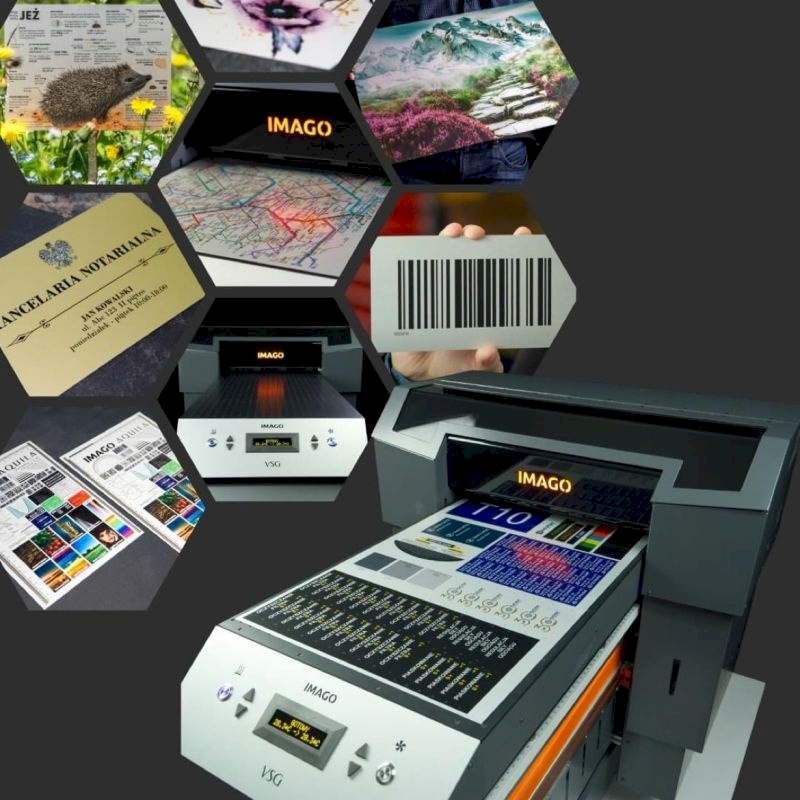
Image showing the beautiful Imago Aluminium Printer made in Poland
When should sub-surface anodised printing be used?
There are many thousands of applications, but in general, sub-surface printing is used when the tag, sign or label, needs to be tough, resistant to scratches and bumps, impervious to volatile chemcals and capable of withstanding huge temperature ranges.
For these reasons, sub-surface printing is used on tags and signs that can be subject to harsh conditions - such as exposure to acids, high temperature, or corrosive fluids and gases. Hundreds of thousands of companies in the petro-chemical, electronics and aviation industry use sub-surface printed aluminium labels, tags and signs.
It has a very attractive look and feel. Top-quality electronics goods (hi-fi sets) apply sub-surface techniques to make fascia panels for their products.
Ultra-thin aluminum labels that are sub-surface printed are used exclusively on the International Space Station. You will also find them on and in submarines, where the corrosive action of sea-water have no adverse effect on the material.
You will find them labelling objects that need to be heated to hgh temperatures and you will also find them in aircraft which fly into atmospheric zones where temparatures go as low as minus 70 degrees celsius.
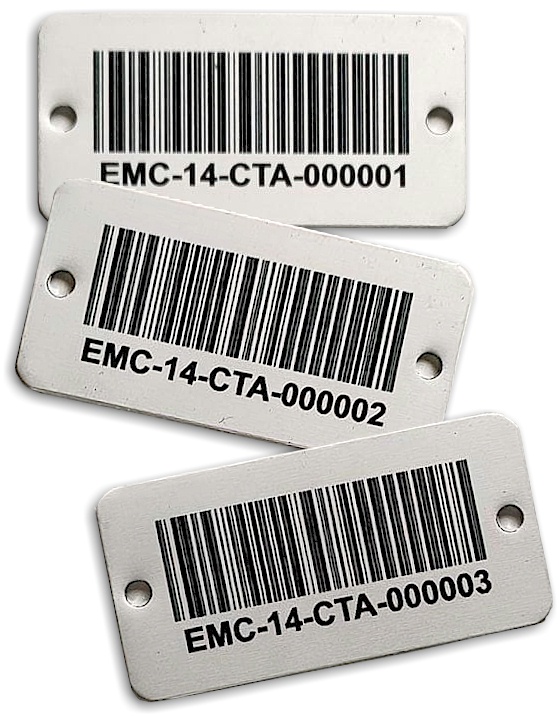
Printed Anodised tags can be individually and sequentially numbered, with or without barcodes, and with any coding combinations needed.
How expensive is it?
Surprisingly, sub-surface printed aluminium is relatively cheap - especially for bulk orders comprising hundreds or even thousands of tags. The process, while simple to undertake, requires precision machinery and special dyes to create a graphic onto a prepared surface.
TagMakers works with a few partner companies to produce sub-surface printed aluminium objects. These partners specialise in this sort of work, and have developed the expertise needed over many years.
Do I need sub-surface printed aluminium for my project?
Best way to find out is to complete our ONLINE QUOTE REQUEST. If your environment needs a precision-marked tag, that will be subjected to any kind of harsh treatment, you would probably be making a good choice.
Let us know what you need such durable tags for. We'll give you proper advice and excellent prices.